Police Records can be located in minutes when you know which agency holds the file and which online tools to use. Begin at the state police record archive or the police report online portal, then narrow results with police record search tips such as searching by name, incident date, or case number. Most jurisdictions list incident, offense, accident, investigative, supplemental, and dispatch records publicly, though a modest police record retrieval fee may apply for extra copies.
Police Records requested by mail follow a simple police file request template: include full name, date of birth, and purpose such as a police report for insurance claim or employment background screening. The request police records by mail must respect police record confidentiality laws and may be subject to police record sealing guidelines if the file contains juvenile or expunged information. Use a police report verification service to confirm details and, if needed, submit a police report correction procedure.
How to Search Police Records
Police records are agency files that document a call, traffic stop, arrest, crash, investigation, or another police action. Additionally, official arrest index resources help verify that a search helps you identify the agency that holds the file, narrow down the correct report, and request the records needed for an insurance claim, court matter, employment review, or personal check. Record names differ by agency, so an incident number may appear as a case number, report number, or file number. For Kane County, the official starting point is the Sheriff’s Office page listed below; it is a contact and routing page rather than a statewide incident-report database.
Official Search Portal: https://www.kanesheriff.com/pages/contacts.aspx
Steps to Search
- Identify the reporting agency from the report number, officer name, or incident location. Use the Kane County Sheriff’s Office for a file created by that office and the relevant city police department for a file bearing its name.
- Use the official contact page to locate the current records request method and the proper office for police reports, Freedom of Information Act requests, or court-related records.
- Prepare a written request with your full name, date of birth, incident date, location, report or case number, and the record types you need.
- Ask the agency to confirm any copy charge, accepted payment method, delivery format, and availability of certified copies before sending payment.
- Review the report number, incident date, location, names, and sequence of documents after receipt. Report any mismatch to the originating agency for correction review.
Kane County IL Police Record Types
Police agencies use different document titles for records created during the same event. A request for “everything about the incident” may therefore need several exact document names. The following types cover many routine requests made to the Kane County Sheriff’s Office, municipal police departments, and other agencies.
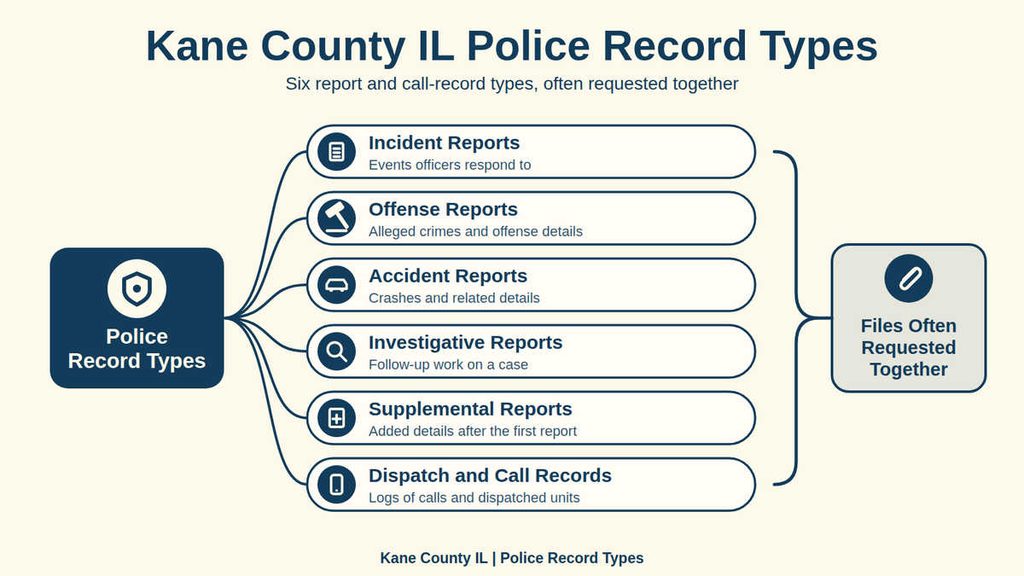
Incident Reports
An incident report is the main narrative created for a call or event. It may list the date and time of arrival, the address, responding units, reported conditions, damage, statements, citations, or an arrest. The narrative records what officers observed and what people reported. It does not by itself decide a civil claim, a criminal case, or the accuracy of every statement within the report.
Offense Reports
An offense report documents a suspected criminal act or a citation. It may contain the legal charge, arrest details, property involved, evidence collected, and the officer’s observations. Some agencies combine the incident and offense narratives into one document, while others keep them separate. A recorded arrest also remains distinct from a conviction or a final court judgment.
Accident Reports
Accident or crash reports record vehicle collisions and may include diagrams, vehicle positions, reported injuries, road conditions, damage estimates, registration data, and insurance details. Some crash data also moves through the Illinois Department of Transportation crash-report process, so state your need for a police report, a state crash report, or both. A crash report describes the reported event but does not decide fault, damages, or insurance coverage.
Investigative Reports
Investigative reports contain work performed by detectives or assigned investigators. They may cover evidence collection, interviews, searches, surveillance summaries, case status, and leads that were not pursued. Portions of an active investigative file may be withheld under a statutory exemption. Even after a case closes, some material can remain protected by privacy, juvenile, or court-order rules.
Supplemental Reports
A supplemental report adds facts, evidence, follow-up contacts, or case developments after the original report was completed. It normally supplements rather than replaces the first report. A complete request may need both documents, especially for a later arrest, a corrected account, additional damage, or a case status that changed during the investigation.
Dispatch and Call Records
Dispatch and call records describe how an emergency or non-emergency call entered the system and how units were assigned. They may contain call times, unit times, call-type codes, caller details, and notes that never appeared in the case report. These records are often stored separately from the investigative file. Recorded audio, if retained, may require its own request because it is a different media record.
Files Often Requested Together
A clear request can name the documents needed for the intended use. These combinations prevent a search from returning only one part of a case file.
- Request the original incident narrative and any later supplemental narrative.
- For a crash, request the main report, diagram, property-damage pages, and later supplements.
- For an arrest, request the incident or offense report, booking details held by the agency, and any available case-status record.
- For a disputed event, request the dispatch timeline and the related written report.
- For an official use, ask whether the agency offers a certified copy or a signed verification document.
Police Records by Reporting Agency
The agency named on the report controls the original police file. Event location helps identify that agency, yet an address alone may not settle the matter because city boundaries, contracted police services, state police jurisdiction, and roadway crossings can affect who responded. Use every clue on the report, including the agency name, report prefix, badge number, unit call sign, and case number.
Determining the Correct Agency
Begin with the agency shown on any citation, warning, crash form, or case page. If no form is available, call the department named in the location only after checking its service area. A county sheriff’s office may provide police service for a municipality under contract, so the postal city may differ from the responding agency. Report the full street address, cross streets, route number, or mile marker to avoid sending the request to the wrong office.
When the event occurred near a county line, use the agency named by the responding officer rather than assuming the county where the mailbox sits controls the file. When a crash moved vehicles across a boundary, the agency that investigated the crash may still hold the report even if the collision began elsewhere.
State Police and Criminal History Requests
The Illinois State Police does not serve as a single online archive for every local police incident report. Its name-based criminal history request service is a separate product for criminal-history details maintained by that agency. It does not replace the local police department or sheriff’s office that created an incident file. A person seeking arrest details should decide whether the need concerns a police report, a criminal-history request, or a court case, since each record covers a different part of the event.
Public Inspection and Disclosure Rules
Illinois’s Freedom of Information Act, 5 ILCS 140, creates a public right to inspect many government records, subject to statutory exemptions and court orders. Police records are not public merely because a police agency created them. The agency must review the file, identify material that can be released, apply any required redactions, and provide a written decision when it withholds records.
Publicly Available Record Content
A released file may contain the main report, supplemental reports, a crash diagram, citation, property list, or other records held in the agency’s custody. A request cannot require the agency to create a record that never existed or to provide material outside its possession. It also cannot replace criminal discovery in a pending case, where the prosecutor and defense counsel follow court rules for exchanging evidence.
Records Exempt From Disclosure
Section 7 of the Illinois Freedom of Information Act lists categories that may be withheld, including active investigative material, personal privacy interests, confidential sources, juvenile records, and certain internal police material. The agency should identify the exemption it claims rather than reject a request with only a general statement. Some exempt material may be released by agreement, or a non-exempt portion may be separated and released after redaction.
Redacted Copies
A redacted copy removes only the protected fields that prevent release. Common examples include a home address, a personal phone number, juvenile identifying details, or sensitive investigative material. Ask for the page number and legal basis for each redaction. If the requester disputes the decision, the written response should state the right to seek review in the proper court.
Juvenile Information Restrictions
Juvenile records receive separate protection under the Illinois Juvenile Justice Act. A parent, guardian, party, court, school, or another authorized recipient may qualify for inspection under a statutory exception. The requester normally must provide proof of the qualifying relationship. A police incident involving a juvenile does not make every juvenile record open to the public.
Sealing, Expungement, and Visibility
Under the Illinois Clean Slate Act, many qualifying adult convictions are sealed automatically after the required waiting period, with exceptions for certain offenses. Other sealing or expungement relief may require a court petition and order. A sealed record remains a record; sealing changes who may see it rather than proving the event never occurred. Court orders, agency indexes, and criminal-history search results may also update on different schedules.
An expungement request belongs in the proper court process, not in an ordinary request to the police records unit. After a qualifying order, submit the order to the record custodian and ask how the agency’s index will be updated. Keep the court docket and agency response together for later verification.
Writing a Clear Police Records Request
A written request gives the agency enough facts to locate the correct file and distinguish your request from a broad search. Illinois agencies may accept requests through an official form, email, mail, or an in-person process, depending on the office. The submitted fields should match the agency’s current instructions, and the request should remain focused on specific records rather than every document connected to a person’s name.
Required Request Details
- Your full legal name, including middle names and any former name used during the incident.
- Your date of birth, used to distinguish records with similar names.
- The exact incident date and a practical date range if the exact time is unknown.
- The complete incident location, including street, cross streets, route number, or mile marker.
- The report, case, incident, citation, or file number printed on any known document.
- The name of the reporting agency and the officer, deputy, or unit, if known.
- The record types requested, such as the incident report, supplements, crash diagram, dispatch record, or investigative report.
- Your mailing address, email address, and phone number for status and delivery purposes.
- The preferred copy format and whether a certified copy is needed.
- The purpose of the request when the agency asks for it or when it helps narrow the records sought.
- Proof of identity or written authority when requesting records for another person.
Police File Request Template
Begin a written request with the subject line, “Request for police records,” followed by a statement that asks the agency to provide the records described under the Illinois Freedom of Information Act. Identify yourself by full name, date of birth, and contact details. List the incident date, location, agency, report or case number, people involved, and every document sought. State the preferred delivery method and ask the agency to confirm the current fee, payment method, and certified-copy options before processing a paid request. End the request with your signature and date.
This structure gives an agency enough detail to begin a records search. Remove requests for documents you do not need, since a narrow request can shorten review and reduce the chance that unrelated protected records enter the file.
Request by Email, Mail, or In Person
Use the submission method listed by the office handling the request. An email request should contain the same written details as a mailed request and should attach scans only when the agency accepts them. For a mail request, sign the letter and include a signed copy of any required form. Do not send cash through the mail. For an in-person request, bring photo identification and the identifying facts listed above.
Third-party people-search and report websites are private services rather than official repositories. Their results may be incomplete, outdated, or mixed across jurisdictions. A paid result from one of these sites does not replace a copy issued by the agency that created the record.
Fees, Copies, and Certified Versions
A public record is not automatically free to copy. Illinois law permits reasonable reproduction charges and applies separate cost rules to commercial requests. The agency should state the charge basis before payment. Ask for the current Kane County fee rather than relying on a rate posted by another agency or a third-party website.
Ask whether standard paper copies, electronic delivery, and certified copies are available. A certified copy carries an agency or custodian attestation concerning the document; it does not guarantee that every statement in the report is true. An insurer, court, or employer may request a certified copy, so state the intended use before ordering.
Identity and Authority to Request
A request for your own record normally requires enough identifying facts to prevent an accidental disclosure to the wrong person. A request for another person’s record may require a signed authorization, a power of attorney, or proof of legal authority. Records involving a juvenile, a sealed case, or a protected victim can have stricter rules. Do not send a full Social Security number unless the official form specifically asks for it.
Police Records Request Timeline and Appeal Rights
Under 5 ILCS 140/9, a public body must notify the requester of its decision within five business days after receiving a written request. In addition, consulting official police blotter records confirms that after deciding to comply, the agency must produce responsive records within five business days, subject to statutory exceptions and agreed extensions. That decision period is not a promise that every requested record will be ready on the fifth day.
If the agency denies all or part of a request, the written decision should explain the reasons, identify the deciding official, and state appeal rights. Under 5 ILCS 140/11, a requester has 60 days from the agency’s final determination to seek review in the circuit court for the county where the records are kept. An attorney can assess deadlines and the proper filing process for a disputed denial.
Police Records Uses
The proper record depends on the result you need. A police report describes the agency’s response to an event, a criminal-history record summarizes prior case outcomes, and a court file contains filings and orders. Naming the intended result helps prevent an incomplete request.
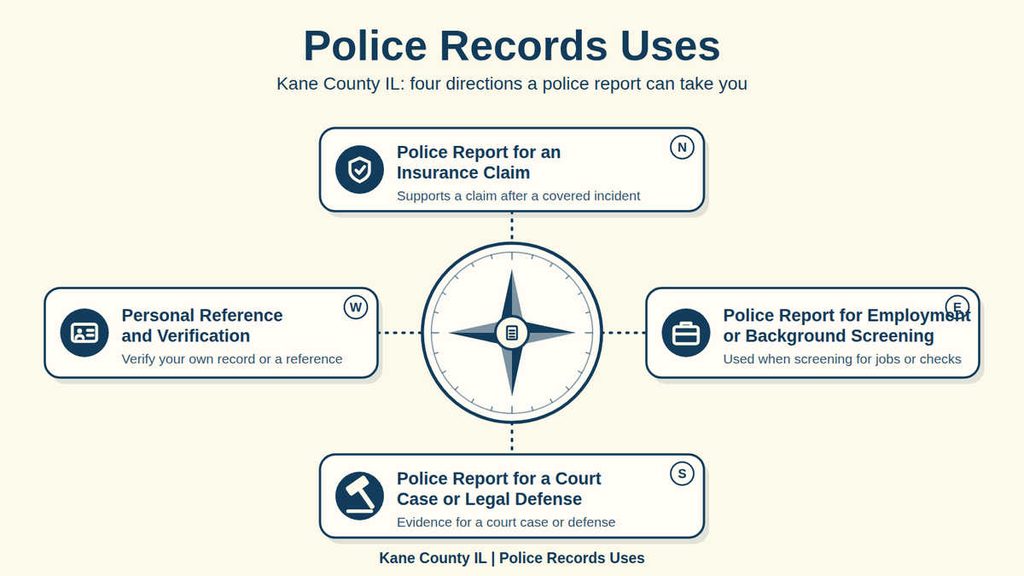
Police Report for an Insurance Claim
An insurer may request the crash report directly or ask the policyholder to supply it. A useful request names the collision date, location, report number, and vehicle involved, then asks for the full crash packet. The packet may include the main narrative, diagram, property-damage pages, and later supplements. The report records the event and reported observations; it does not decide which party receives payment.
Police Report for Employment or Background Screening
An arrest shown in a background report is not the same as a conviction. Request the current case status and disposition when a screening result includes an arrest that has not yet appeared in a criminal-history search. If a consumer reporting agency supplies inaccurate or incomplete arrest details, the consumer can dispute the report with that company and request a review under the Fair Credit Reporting Act.
Police Report for a Court Case or Legal Defense
Court filings, docket entries, and orders come from the clerk of the circuit court. The police report comes from the police agency, and much of the evidence used in a case may be exchanged through criminal discovery. A public-records request can obtain the released report, but it may not include every statement, exhibit, recording, or confidential investigative file.
Personal Reference and Verification
For a personal reference request, identify the exact document and ask whether the agency can verify its issuance. Do not assume that every agency offers a standalone verification letter. A report number, agency confirmation, and certified copy can serve different purposes, so state whether you need proof that the document exists or a certified copy of its full content.
Updates and Corrections
Corrections can take several forms. A supplemental report adds new facts, an administrative correction fixes an indexing error, and a formal correction addresses a stated factual mistake. Each form serves a different purpose. Keep the original document, identify the exact disputed entry, and request a dated correction or clarifying supplement from the record custodian.
Supplemental Reports
A supplemental report records later developments without erasing the original narrative. It may be used to add an arrest, identify recovered property, describe additional damage, or close an investigative step. When reviewing a file, compare the original and every supplement in date order. A supplement can clarify the event without proving that every statement in the first report was mistaken.
Updated Case Information
Changes in arrest status, charges, plea, sentence, dismissal, or conviction may come from the court rather than the police agency. The court clerk can supply the current docket and orders. Ask the police custodian to correct agency fields that conflict with a court record, and keep the court document with the correction request as proof.
Corrected Reports
A reporting officer or records supervisor may correct a clear clerical mistake, such as a transposed date, misspelled street name, or copied report number. The agency may issue a corrected page, a correction memorandum, or a supplemental statement. A disagreement over what happened at the scene may require a fuller review and cannot be resolved by the requester alone.
Administrative Changes
Administrative corrections cover filing and indexing details, including a wrong report number, duplicate scan, name formatting, file location, or agency label. They do not change the facts of the incident. If a search returns two copies or no result, request a records index check before assuming the file was never created.
Requesting a Record Correction
Send the correction request to the originating agency’s records unit. State the report or case number, identify the page and exact entry, explain the correct fact, and attach supporting proof such as a citation, crash form, court order, or witness statement. Say whether you want the original page replaced, a corrected page added, a correction memorandum, or a supplemental report. The agency may accept the correction, add a clarifying note, or explain that the original entry must remain.
Police Records Verification
Verification means matching the copy to the correct agency, event, and person. Report numbers are unique within an agency’s system rather than across all police records, so the agency name must travel with the number. A police report verification service from a third party can check formatting, yet it cannot authenticate an official record by itself.
Comparing Original and Supplemental Records
Place the original narrative before the supplements and compare dates, authors, and stated facts. Supplemental pages often correct a missing detail rather than replace the original event account. If the supplement changes a material point, ask the agency which document is the current case record and whether a correction memorandum exists.
Certified and Stamped Copies
Ask the records unit whether it can issue a certified copy or apply an official validation mark. Certification confirms the document’s status as a record held or issued by the named agency. It does not certify the accuracy of every fact reported by the officer or witness. For a court or insurer, confirm which version the recipient requires before spending money on multiple copies.
Police Records Search Problems
Most missing-result problems come from an incorrect agency, an incomplete identifier, a recent record still being processed, or a lawful restriction. Work through one issue at a time and keep written proof of each request. A fee paid to a third-party search site does not create an official record or remove a statutory restriction.
Delayed Record Availability
New records often need time for factual review, redaction, scanning, and signature before release. Ask for a status date and the name of the unit handling the request. If the statutory decision period passes without a response, send a written follow-up rather than paying another third party to repeat the search.
Escalating a Missing or Denied Record
Keep copies of the request, proof of delivery, payment receipt, agency response, and every identifying document sent with the request. Ask the records supervisor to review the search criteria if the file is missing. For a formal denial, use the appeal process stated in the agency’s written response and obtain legal advice before the 60-day filing deadline expires.
Contact Information
Use these official contact details for the Kane County Sheriff’s Office. Neither listed phone line should be used to report an emergency. The office can provide information about law enforcement matters, public safety, and available departmental services. Contact staff during the appropriate business hours for general inquiries. For urgent situations requiring immediate assistance, use the appropriate emergency reporting channel instead. Check the Sheriff’s Office website for current contact information and service updates.
Frequently Asked Questions
Police records hold details about arrests, traffic stops, incidents, and investigations. Accessing these files helps with insurance claims, court cases, job applications, and personal checks. Knowing how to request, verify, and correct a report can save time and avoid costly mistakes. Below are common questions about obtaining and using police records, especially for Kane County residents.
How can I request a police record online in Kane County?
Visit the Kane County Sheriff’s online portal, locate the “Record Request” section, and enter the incident number, name, or date range. Upload a valid ID, choose the record type, and pay the $15 retrieval fee with a credit card. After submission, the office emails a PDF link within three business days. Keep the confirmation number for follow‑up calls to 630‑232‑6840.
What is the fee for a police record retrieval and are there any waivers?
The standard charge is $15 per document. If the request is for a court‑ordered matter, the fee may be waived with a signed subpoena. Non‑profit organizations can ask for a fee reduction by submitting a written request that explains the public interest purpose. Payments must be made before the file is released.
Can I obtain a police incident report free for an insurance claim?
Yes. Illinois law permits a free copy of an incident report when it is needed for an insurance claim. Submit a written request stating the claim purpose, include the claim number, and attach a copy of the insurance notice. The sheriff’s office will provide the report without charge within five business days.
How do I correct an error on a police report?
Start by contacting the records division at 630‑232‑8400 and ask for the correction form. Fill out the form with the correct details, attach supporting documents, and sign the affidavit. Return the package by mail or email. The agency reviews the request and issues an amended report, usually within ten business days.
What steps are needed to seal or expunge a police arrest record?
First, verify eligibility under Illinois expungement law; most felonies and certain misdemeanors qualify after a waiting period. File a petition in the circuit court where the arrest occurred, attach the arrest record, and pay the filing fee. After the court signs the order, send a copy to the Kane County Sheriff’s Office to have the record sealed. Expect a processing time of four to six weeks.